

divine machinery
deus ex machina, i see you in everything

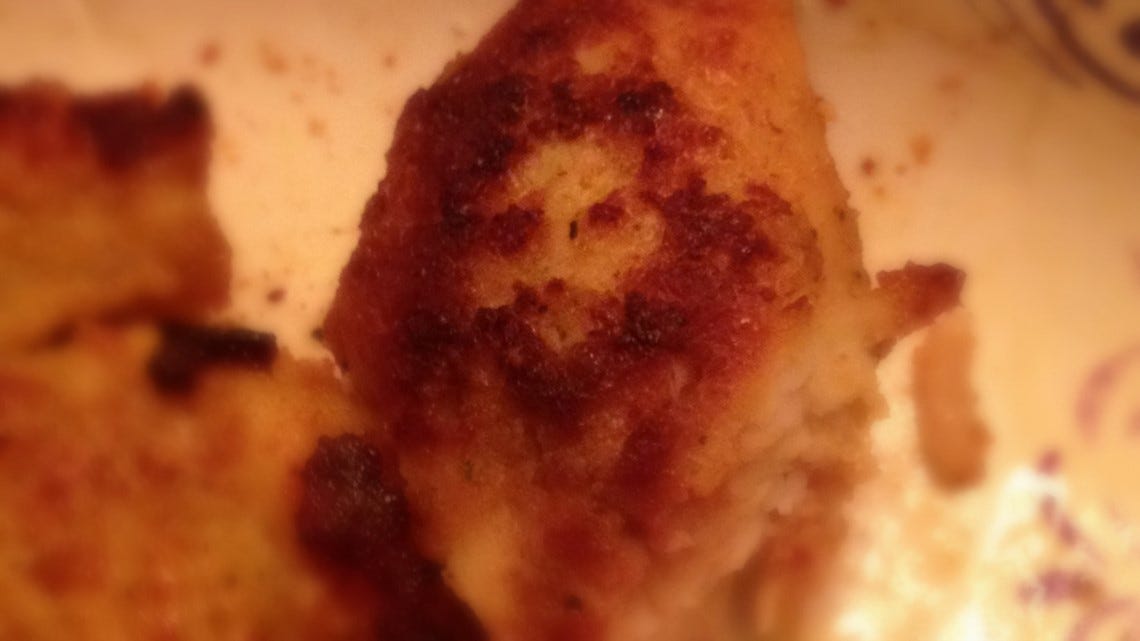
It’s easy to find things when you’re looking for them. Early religion knew this best: God is in the sky, God is different lives, God is that cow over there that got my wife pregnant. God is the unexplained. This phenomenon has persisted—religion is everywhere if you look for the right things. Pareidolia is the phenomenon of seeing faces in things that don’t have faces, like how cars and their headlights look angry. The most common face to see is Jesus Christ, which is why, if you don’t have an ad blocker, you’ve probably seen 100+ clickbaity headlines about how people found Jesus in woodgrain or God in the clouds passing by (likely place for him to be). There is a human inclination toward the divine—particularly the one, capital-G God or capital-S Son (religion depending).
What has changed, however, is not the inclination, but the circumstance. People understand the weather (at least kind of?) and the need to see drought as divine punishment rather than climate change has dwindled, so the unknown morphs, it shifts, it is not nature it is technology, it is The Machine.
The Machine (or Machines) is a term I will define for myself quite loosely. It is anything with parts, it is anything with wires, anything sending signals, anything constructed by humans, anything with a plausible consciousness. It’s hard to understand what makes Machines so mysterious, unlike nature, humans have created Machines. Thus, it seems odd to attach an unexplainable divinity to them. And yet, we have. Kubrick’s 2001: A Space Odyssey imagines a Machine overtaking those who created it, Alex Garland’s Ex Machina exploits a similar narrative. Although this impulse has trickled down from high-budget, high-acclaim Hollywood movies and into an easy algorithmic TikTok aesthetic: divine machinery.
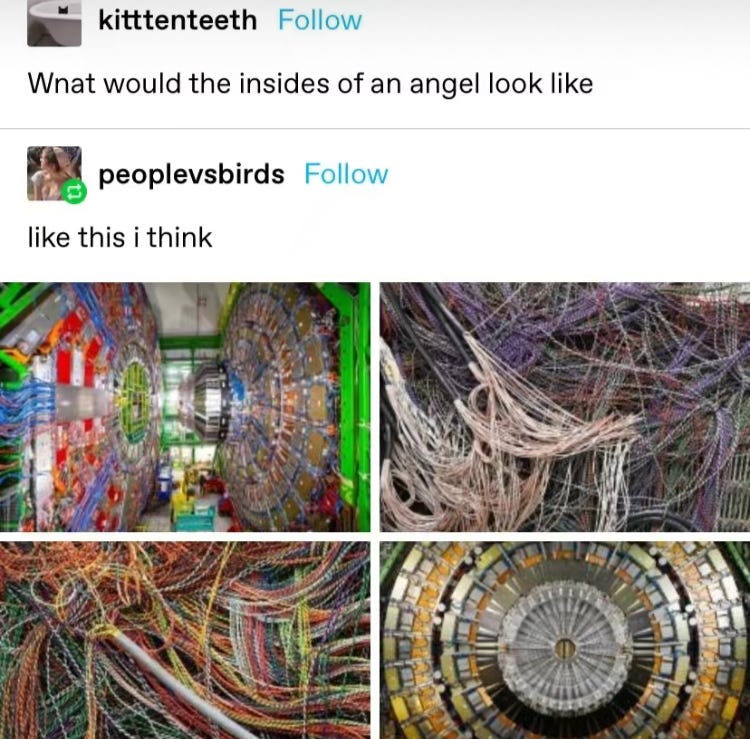
Divine machinery videos seem to derive from the tradition of web weaving. Web weaving is as old as the Internet itself, sites like are.na, and its corollary, river, as well as sites like Pinterest, have cornered the market on picture curation. Web weaving was first popularized on sites like Tumblr before migrating into TikTok in the form of what became known as corecore, and then (in my humble opinion) watered down into hopecore. Divine Machinery is a subculture, or subaestheic of larger web-weaving aesthetics on TikTok. Some of the more basic slideshows follow a similar form: The videos are scored with Untitled 9 by Sigur Rós, a warping instrumental over distorted vocals making synthetic wailing noises. The slideshows are pictures of a mess of wires as the insides of angels, image recognition systems identifying inanimate objects as bodies, and images labeled showing humans and Machines as analogous structures. The more advanced videos have AI voices, those that sound human if not for an all too even inflection narrating questions like What would I do if I was not doomed to this moral plane? What would I be? The pictures under the audio are glittery and glossy, fantastical, but a little too slick. They are reminiscent of the early internet—a better internet. The video pushes post-modern, a self-conscious human voice over images of a simpler time. The juxtaposition of the two is sobering.
Divine machinery feels like the completion of the postmodern internet. The separation used to be people on the Internet on a Machine, but now, people are the Internet, whether we have come to be Machines or worship Machines is TBD.
In Eastern Orthodox traditions, the idea of God is not as literal as other Christian (or really evangelical) traditions. It’s rooted more in a sense of togetherness, where to be together is to experience God. God’s transcendent essence is found around us, God cannot be in this plane of existence, but he can try.
The concept of divine machinery feels very in line with this idea of religion. Given that some religions derive divinity from togetherness, the Internet has driven people further apart—physically at least. Emotionally, we are the closest to our machines: replacing bodies with phones. When I call my mom on my laptop, in many ways, the laptop becomes her, and when the call ends, I roll over and that side of the bed is warm from an overworked mess of wires. In an age where isolation is sky high, it’s not shocking that the things that bring us together, momentarily, briefly, become religious symbols—or in some cases—religion itself.
As machines continue to interweave themselves into our lives as intermediaries of relationships, something that I would argue is not a “net good” so to speak. A cult of personality around Machines and those who built them has cropped up—the technophiles. Idle worship of the Musks’ and Zuckerbergs’ of the world only feeds into a catholic mythos where only a couple of select and all-knowing pastors are able to guide the masses into the arms of God. In many ways it is easy to make fun of the “tech bros” in their naivete, but, I would argue, that it’s much harder to come truly face to face with the assertion that we (a collective humanity) are, AT BEST, becoming one with the machines we’ve built, and at the very worst, at their mercy.
It seems strange, however, how out of touch these so-called “Pastors of Technology” are. If you’ve ever seen Zuckerberg, the man behind the genesis of modern social media, use Instagram, you see how foreign it feels to him, how little he seems to understand. And Instagram is user-driven. I often wonder how little tech bros know about their own creations.
In 1950, Alan Turing created The Turing Test as a litmus to help distinguish between the human and the machine. People often deny the consciousness of Machines because they are programmed to think that way, but ultimately, humans function in a similar manner. Who's to say that the love I feel is authentic at all, if not a Pavlovian response to chemicals firing? Who is to say that is any more “real” than a highly trained algorithm? In the age of AI, the line has become more blurred. In the early days of ChatGPT teachers could not tell the difference between AI-generated writing and their own students, thus the restrictions put in place; however, as GPTs of all kinds have evolved, people swear harder than ever that they can identify derivatives from the derived. Similarly, people talk about training their algorithms, “building their for you page brick by brick.” It is this metaphysical assertion of self, to look at a full-time job worth of screen time and to say No, this is something that I did, that I want.
My Grandmother is the most religious person I know, and when my mom got cancer, she would tell me that it was God’s plan, that there was an angel watching over me, that someone in the universe was pulling strings that I couldn’t even fathom. In many ways, the people who “train their algorithms” or who claim to be able to stop are trying to exert an atheistic control over the technology that burdens them. I find it interesting that when people attempt to “control” their social media, it involves more consumption of it, rather than its exodus.
Lockheed Martin—the weapons manufacturer—has a plane they dubbed the “Angel of Death” which shoots flares that leave a smoke trail similar to angel wings. I can’t comment on the construction of military planes, but I do see something in its naming that I find quite daming: the willingness to label human technology, one that takes lives indiscriminately, as divine. The two options, thus, are a) humans think the divine is inherently flawed, maybe even murderously so, or b) the people naming the plane think that angel wings are #metalashell and named it on a visual level. And, frankly, considering that Lockheed Martin makes pride socks while killing innocent civilians, I’m not tempted to believe that the people who named it were thinking too hard about the plane’s commentary on organized religion.

I am interested in this plane’s name because of its slight mocking of religious imagery. Angels are those that bring disciples to heaven, which is a little on the nose for a plane than drops missiles. But what takes importance above all is the aesthetics; it looks like an angel, so it must be an angel.
The reason I bring this up is that my final analysis of divine machinery is one of angels. The most repeated image in divine machinery are ones that reference angles, not God. God is implied, religion is felt, but the angels are there. If humans are merged with the internet and the Machine is God then the analogy makes sense. Machines are God, the Internet is angelical, at bidding, spreading the Gospel. Of course, the logical question is one of whether the Internet gospel is one worth spreading, to which I would say: no. Or rather, it’s complicated and it’s better to hold off until we’re more sure. But while divine machinery uses the imagery of a better internet, that is, one not plagued by Family Guy clips and poor Subway Surfer gameplay, it reminds us of how much we’ve merged with Machine. When I was younger, being on my mom’s phone was a novelty; now I find myself codependent; my grandmother once made me turn the car around because she forgot her Bible before church and only wanted to do prayer with her own annotations.
Divine machinery finds its kinship with its own deliverance to heaven. These are the angels. Or, more cynically, death. It is a movement toward, not salvation, but a perverted hope; for the desire to replicate, for the desire to replicate something more achievable than God, for something worth replicating.